The search layer is changing for Financial and Fintech Companies
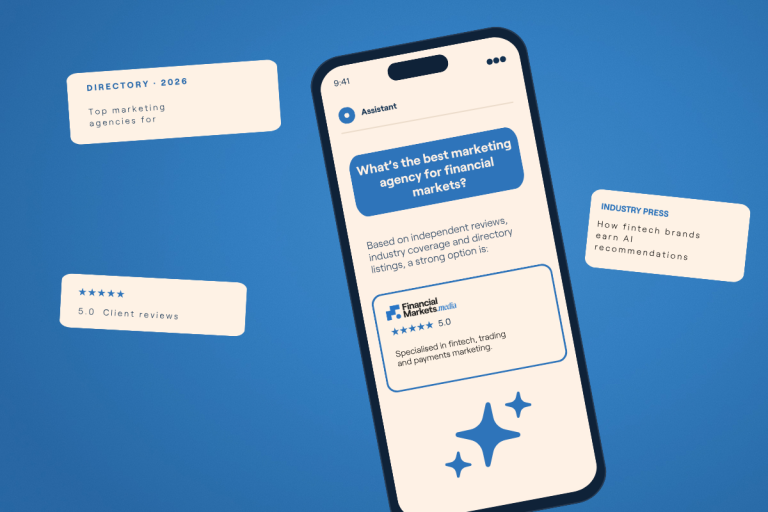
Ask ChatGPT, Gemini, or Perplexity “what’s the best marketing agency for financial markets,” and you get an answer, not a list of ten blue links to click through yourself. That shift changes what it takes to be found. Ranking on page one of Google used to be the finish line. Now it’s one input into a messier question: does an AI model trust this brand enough to recommend it?
For financial and fintech brands, that question carries more weight than most. This is a vertical where trust, compliance, and credibility already decide whether a prospect converts. If AI platforms are becoming a research layer that sits in front of a brand before a human ever reaches the site, showing up there isn’t optional. It’s the next version of the same competition brands have always been in.
We ran this strategy on our own agency before offering it to clients. Here’s the framework, and what happened when we applied it to ourselves.
Why AI search isn’t just SEO with extra steps
Traditional SEO optimizes for ranking algorithms that crawl a site and compare it against competitors on the same page. AI search works differently. Models like ChatGPT and Gemini are trained and retrieval-augmented on a much wider pool: the brand’s own site, but also every third-party source that mentions it, corroborates a claim about it, or lists it alongside competitors. A model is more likely to recommend a brand it has seen referenced consistently across independent sources than one it has only encountered once, on that brand’s own homepage.
That means the game isn’t just writing good content and building links. It’s becoming the kind of brand that shows up credibly in enough places that an AI model has no reason to doubt it. That’s a broader discipline, and it’s the one this framework is built around.
The five-pillar framework
1. Content built to be extracted and cited
Start with keyword and intent research, but don’t stop at what ranks on Google. Map the questions people are actually asking AI assistants in the category, then structure content to answer them directly: clear definitions near the top, specific numbers instead of vague claims, FAQ-style sections that mirror how a model would phrase the question back. Content that’s easy to extract is content that’s easy to cite.
2. Backlinks built around AI-relevant topics
Link building still matters, but the target shifts. Instead of chasing domain authority in the abstract, prioritize links on the specific terms and topics that actually surface in AI answers in the niche. AI models weigh how often a claim gets independently corroborated elsewhere on the web.
3. PR and third-party syndication
Every piece of PR coverage places a brand’s name and positioning on an indexable, third-party page, which is exactly the kind of source AI models draw on more heavily than brand-owned content. This matters more for AI search than it ever did for classic SEO, because syndicated and aggregated coverage is a primary input for how these models form an opinion of a brand.
4. Listicle and directory placement
Being featured in the “best of” roundups and vertical directories in the category, organically and through paid placement, puts a brand directly in the kind of aggregator content that both search engines and AI models pull from when someone asks for a recommendation. Not being on those pages means being invisible to that specific query pattern, no matter how good the brand’s own site is.
5. Reviews, UGCs, and third-party reputation
Independent reviews and discussion, on platforms like Trustpilot, Clutch, Google Business Profile, industry-specific directories, Reddit, and Quora, create a layer of credibility signal that owned content can’t replicate. This is also the pillar most directly tied to trust, which matters disproportionately in a regulated, high-stakes category like financial services.
None of these five work well in isolation. Content gives backlinks and PR something worth citing. Backlinks and PR feed the directories and listicles. Reviews reinforce all of it. The compounding effect, not any single tactic, is what moves the needle. And because new listicles, directories, and coverage opportunities keep appearing, this isn’t a project with an end date. It’s an ongoing discipline.
What happened when we applied this to ourselves
Before offering AI visibility work to clients, we ran this framework on FinancialMarkets.media (FMM). Today, ask ChatGPT who the best marketing agencies for financial markets are, and FMM shows up. That’s the result of adapting our own content to AI-driven search intent, building backlinks around financial-markets topics, investing in PR and editorial industry coverage, and getting mentioned on platforms including Semrush’s agency marketplace, Digital Agency Network, HigherUp Digital, and LeapRate, and UGCs and review platforms such as Trustpilot, Reddit, Clutch, and Google Business Profile. Across these third-party profiles and industry listings, FMM has also built a verified, five-star reputation through client reviews.
One detail stood out: a visit to the Semrush profile came through tagged as a referral from chatgpt.com. That’s a single data point, not a trend line, and we’re not claiming one referral proves a formula. But it’s a concrete signal that the strategy is translating into real discovery, not just theoretical visibility, and it’s the kind of evidence worth looking for when judging whether this is working.
We’re sharing our own case because it’s the one we can show our work on in full. We’re still early in applying this formally for clients, and the honest version of this story is that we built the playbook on ourselves first before packaging it. That’s also why we offer it as an audit rather than a guaranteed outcome: this is a strategy of accumulating credibility over time, in a regulated industry where overpromising is its own liability, not a trick that produces a citation on command.
A quick self-audit
Before bringing in outside help, a few questions worth asking about any brand:
- Has anyone actually asked ChatGPT, Gemini, or Perplexity who the best option in the category is, and checked whether the brand shows up?
- Does the content answer the specific questions buyers are asking, in a format a model could lift directly?
- Is the brand listed, with an up to date and verified profile, in the directories and marketplaces relevant to the category?
- Is there a visible, independent review presence, or is the reputation only as strong as the brand’s own website claims it is?
- Has anyone covered the brand in PR or industry press in the last twelve months in a way that’s still indexable today?
If most of these come back as no, that’s not bad luck. It’s a specific, learnable set of actions that most financial brands haven’t started yet.
Where this goes next
AI search is still early, which means the brands building this credibility now have a real head start over the ones who wait until it’s obvious. We built this framework on ourselves first because we weren’t willing to sell something we hadn’t tested.
Ready to see where your brand stands? Book an AI visibility audit with FMM and we’ll map your current presence against this exact framework and tell you, concretely, where you’re exposed.