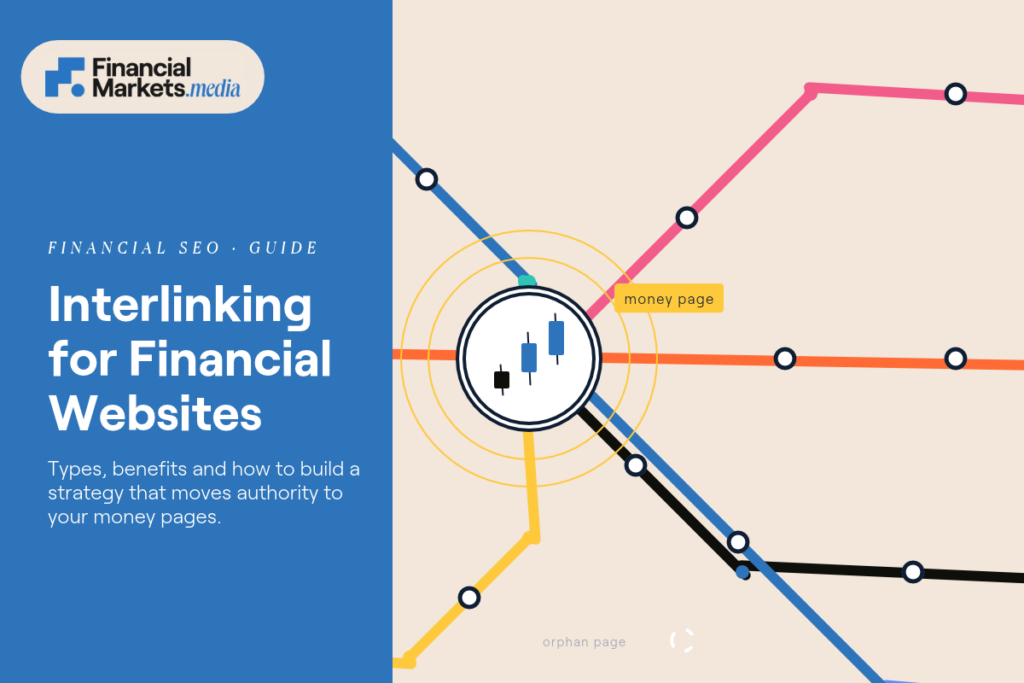
Most financial websites have the same problem. Their money pages, such as account opening, trading platforms, instrument pages and pricing, earn almost no backlinks. Meanwhile, the blog, education hub and market analysis attract all the links and traffic. Interlinking moves that authority to the pages that convert.
This guide explains what interlinking is, the main types, the benefits for financial SEO and users, and how brokers, fintechs and crypto platforms can build an internal linking strategy that works in a regulated sector.
What is interlinking?
Interlinking, also called internal linking, means linking one page of a website to another page on the same domain. A link from your “What is CFD trading?” guide to your CFD instruments page is an internal link. A link from FXStreet to your homepage is an external link, or backlink.
Good interlinking has three parts:
- A logical structure. Links follow the way your site is organised, from broad topics to specific pages.
- Descriptive anchor text. The clickable words tell users and search engines what the target page is about. “Forex trading accounts” works. “Click here” does not.
- Relevance. Each link takes the reader to the next thing they would reasonably want to read or do.
Search engines use internal links to discover pages, understand how they relate, and decide which ones matter most. Users rely on the same links to find their way around. On a financial site with hundreds of instruments, regulatory pages and educational articles, interlinking decides whether a page gets found or stays buried.
How interlinking influences PageRank
PageRank is Google’s original method for scoring a page by the links that point to it. Google no longer shows a public PageRank score, but link-based authority is still one of its ranking signals. The idea stays simple. A page with more links from strong pages is treated as more important, and part of its authority passes on through the links it contains.
Internal links matter because they let you decide where that authority goes. Interlinking affects rankings in three ways.
1. It distributes link equity. Backlinks on a financial site tend to land in a few places: the homepage, research pieces cited by the press, and popular guides. Internal links from those pages pass some of that equity to pages that rarely earn links on their own, such as account types, spreads and fees, or a specific instrument.
2. It improves crawlability. Search engines find pages by following links. A page that is five clicks from the homepage, or has no internal links pointing to it (an orphan page), may be crawled rarely or not at all. This often happens to old market analysis, expired promotions and localised pages on broker sites.
3. It sets hierarchy and context. The pages you link to most, and from the most prominent places, are the ones you are telling Google matter most. The anchor text and surrounding copy explain what each target page is about. If 40 educational articles link to your “Gold trading” page with relevant anchors, Google gets a clear signal about which page should rank for gold trading queries.
Types of interlinking
There is no single correct structure. Most well-built financial sites combine the types below.
| Type | How it works | Financial site example |
| Silo (vertical) | The homepage links to main categories, categories link to subcategories, and subcategories link to individual pages. | Home → Markets → Commodities → Gold CFDs |
| Horizontal | Pages on the same level link to each other. Lower-volume pages link to higher-volume pages. | “Silver CFDs” and “Oil CFDs” link to “Gold CFDs” |
| Difficulty-based | Pages that rank easily link to pages that are hard to rank, to give them more support. | Long-tail guides link to “Best forex broker” or “Forex trading account” |
| Hub and spoke (topic cluster) | One pillar page covers a broad topic. Supporting articles each cover one subtopic, and the pillar and articles link to each other. | “Forex trading guide” pillar with articles on leverage, spreads, pips and lot sizes |
| Contextual | Links inside body copy, placed where the reader needs them. | “Your margin requirement depends on [leverage]” inside a margin article |
| Navigational | Links in menus, footers, breadcrumbs and sidebars that appear site-wide. | Footer links to Regulation, Risk Disclosure and Account Types |
Silo (vertical) structure. This is the backbone of most broker and exchange sites. It mirrors how products are organised (markets, platforms, accounts, education) and keeps related pages together. Its weakness is isolation. If silos never link across, a reader of your crypto education hub may never see your crypto CFD page.
Horizontal structure. Links between sibling pages pass authority sideways and keep users moving. On a site with dozens of instrument pages, link the long tail (exotic pairs, minor commodities) to the pages with the highest search demand (EUR/USD, gold, Nasdaq 100).
Difficulty-based linking. Not every page faces the same competition. A glossary entry on “pip value” can rank with little help. “Forex broker” or “trading platform” is one of the most competitive terms in finance. Point many easy-to-rank pages at the few hard targets. Use the anchors your hard target needs, and vary them so they still read naturally.
Hub and spoke. This is the strongest way to build topical authority, which Google increasingly rewards for YMYL (Your Money or Your Life) topics. A pillar page on a topic, fully covered by linked supporting articles, shows depth that a single page can’t.
Contextual vs navigational. Navigational links tell Google what exists on your site. Contextual links tell it what matters and why. Contextual links in body copy usually carry more weight, because the surrounding text gives them meaning. Use navigation for structure and contextual links for priority.
Benefits of interlinking
1. It defines your web architecture. Think of pages as bricks and internal links as the mortar. Without links, you have a pile of pages and no structure. Internal links show search engines how your site is organised and which sections belong together. They also keep important pages within three clicks of the homepage, where they get crawled often.
2. It improves site navigation. Financial products are complex, and few visitors open an account on their first visit. Internal links guide them through the next steps: from a market news piece to the instrument page, from the instrument page to account types, and from account types to registration or a demo. Good links answer the question “where do I go next?” before the visitor has to ask.
3. It improves user experience. Relevant links to supporting content help readers understand a topic without leaving your site to search elsewhere. A beginner reading about leverage who finds a link to your margin calculator stays with your brand. That means more pages viewed, more time with your content, and more chances to build the trust that financial decisions need.
4. It conveys authority. Internal links pass authority from strong pages to the pages you want to rank. Link from your homepage and best-linked content to priority pages. Vary the anchor text with exact terms, partial matches and long-tail phrases, so the profile looks natural and covers more searches.
5. It reinforces keyword relevance. Anchor text and the copy around a link tell Google what the target page is about. When many pages link to one URL with consistent, relevant anchors, it becomes clear which page should rank for that topic. This also prevents keyword cannibalisation, where two of your pages compete for the same query and both rank worse.
6. It supports E-E-A-T and compliance. Financial content is YMYL content, judged on Experience, Expertise, Authoritativeness and Trust. Consistent links to your regulation page, risk disclosures, author bios and methodology pages show that the content is backed by a real, accountable company. They also help you meet regulators’ expectations that risk information is easy to find.
How to build an internal linking strategy for a financial brand
General interlinking advice assumes a simple site. Financial sites are rarely simple. They run multiple regulated entities, several languages, hundreds of instruments, and content that goes out of date the day after publication. Here is how to approach it.
Step 1: Map your money pages. List the 10–20 pages that drive revenue: account opening, account types, platforms, top instruments, pricing, and your partner or IB programme. These are your link targets. Everything else exists partly to support them.
Step 2: Find where your authority sits. Use Search Console’s Links report, or a tool like Ahrefs or Semrush, to see which pages earn external backlinks. On most broker sites these are the homepage, market research, data-led studies and widely cited guides. These are your link sources.
Step 3: Connect sources to targets. Add contextual links from your strongest pages to your money pages, using relevant anchors. A market analysis article on gold should link to your gold trading page. A study cited by the press should link to the product it relates to.
Step 4: Build topic clusters around commercial themes. Group your education content around the products you sell: forex, CFDs, crypto, stocks, copy trading. Each cluster gets a pillar page that links to the money page for that product, and every supporting article links back to the pillar.
Step 5: Turn time-sensitive content into a linking asset. Daily market news and analysis lose search value quickly, but you publish a lot of it. Use a fixed template with links to the relevant instrument page and one evergreen guide. Hundreds of articles each passing a small amount of authority to the same few pages add up.
Step 6: Respect regulatory and market boundaries. Don’t link users from a jurisdiction’s content to products or entities that aren’t available to them. Keep EU, UK, offshore and other regional sections linked within their own boundaries. Make the risk warning and regulatory pages reachable from every page. A link that is good for SEO but breaks marketing rules is a liability.
Step 7: Handle multilingual sites deliberately. Link within each language version, not across languages in body copy. Use hreflang to connect translations, and make sure every language has its own complete set of internal links to its money pages. Translated pages are often left as orphans, with no links pointing to them.
Examples by business type
| Business | Link sources | Priority targets | Watch out for |
| Forex and CFD broker | Market analysis, education hub, trading calculators | Instrument pages, account types, platforms | Links from one regulated entity’s content to products of another |
| Crypto exchange | Coin explainers, price pages, research reports | Buy/trade pages for each coin, staking, fees | Pages for coins not offered in a jurisdiction |
| Fintech or payments | Use-case guides, integrations, developer docs | Product pages, pricing, demo request | Developer docs cut off from the marketing site |
| B2B liquidity or tech provider | Industry reports, case studies, news | Solution pages, contact sales | Case studies that never link to the product they describe |
Interlinking best practices
- Use descriptive anchor text. “Compare our forex account types” tells users and Google what to expect. “Click here” and “read more” tell them nothing.
- Link only where it’s relevant. Every link should help the reader at that point in the text. If you have to force it, leave it out.
- Keep link counts reasonable. There is no fixed limit, but a page with 150 links spreads its authority thin and reads like a directory. Prioritise.
- Put important links early. Links high in the body copy are more likely to be clicked, and they signal priority.
- Link to the canonical, final URL. Avoid links that go through redirects, tracking parameters or non-canonical versions.
- Audit regularly. Check internal links every quarter. Fix broken links, rescue orphan pages, update links to expired promotions, and add links from new high-authority content to your money pages.
Common interlinking mistakes on financial websites
- Orphan pages. Landing pages for campaigns, regional entities or new instruments that nothing links to.
- Same-keyword competition. Two articles targeting the same term with no links between them, so Google keeps switching between them and neither ranks well.
- Links buried behind JavaScript. Instrument tables or platform widgets that load links in a way crawlers can’t follow.
- Over-optimised anchors. The same exact-match anchor (“best forex broker”) used hundreds of times across the site.
- Content cut off from products. An excellent education hub that never links to the products it is meant to sell.
- Broken links after migrations. Entity changes, rebrands and URL restructures that leave thousands of internal links pointing at redirects or 404s.